
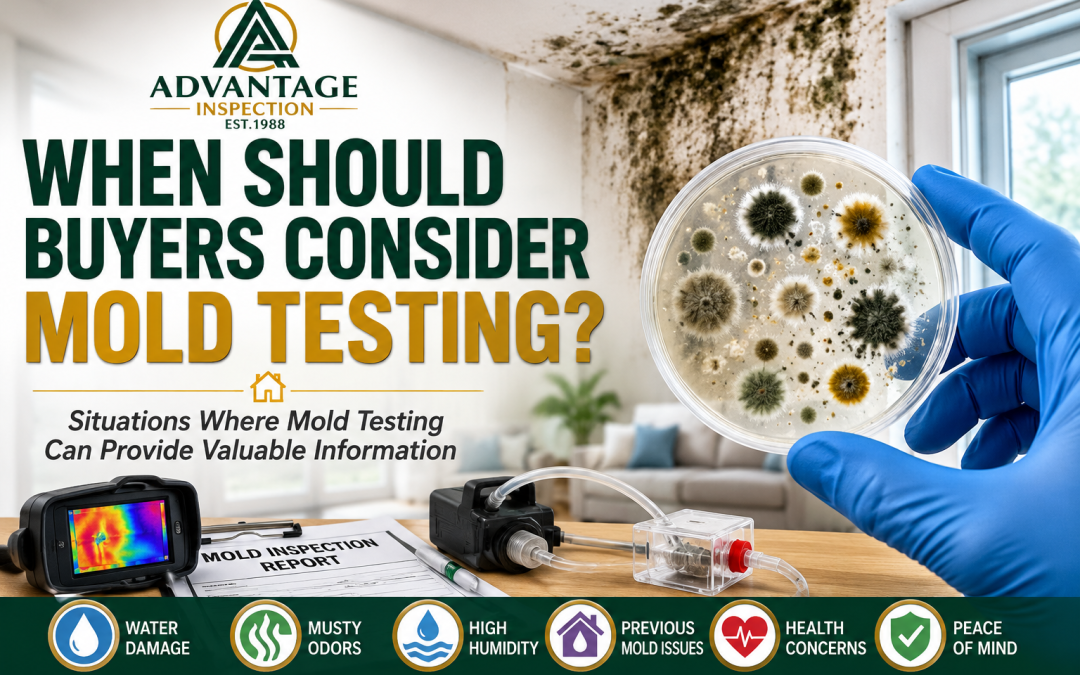
When Should Buyers Consider Mold Testing?
We recently received a question from a Realtor about mold testing and air quality for a home in Raleigh.
Hey Dave,
My buyers are under contract on a home and asked whether they should add mold testing to their inspection. There isn’t any obvious mold visible, but I wasn’t sure what situations would justify recommending it.
When do you typically recommend mold testing during a real estate transaction?
Thanks!
Jennifer
Hey Jennifer,
I usually tell buyers that mold testing is a due diligence tool, just like a sewer scope or radon test. Not every home needs it, but when there are moisture concerns, past water issues, unusual odors, or simply a desire for additional peace of mind, mold testing can provide information that a visual inspection alone cannot.
Cheers
Dave
Let’s get into this topic a little more below!

Mold Testing Is Not Just for Homes With Visible Mold
One of the biggest misconceptions in real estate is that mold testing is only needed when mold is visible.
In reality, mold often grows in places buyers can’t see, including:
- Behind drywall
- Under flooring
- Inside HVAC systems
- Behind cabinets
- Inside crawlspaces
- Attics and insulation
That’s why testing can sometimes be valuable even when a home appears clean and well-maintained.
Situations Where We Commonly Recommend Mold Testing
Water Damage
Past or present water intrusion is one of the biggest reasons to consider testing.
Examples include:
- Roof leaks
- Plumbing leaks
- Flooding
- Basement seepage
- Water stains on ceilings or walls
Growth starts within days after moisture is introduced.
Musty Odors
If a home smells musty, earthy, or damp, mold testing may help determine whether hidden mold growth is affecting indoor air quality.
Many issues are first detected by odor rather than by visible growth.
High Humidity or Moisture Concerns
Homes with:
- Damp crawlspaces
- Condensation on windows
- Poor ventilation
- Excessive indoor humidity
Can create conditions that support growth.
Previous Mold or Water Damage Disclosures
If a seller discloses:
- Prior mold remediation
- Previous flooding
- Water damage repairs
- Moisture intrusion issues
Testing can help buyers better understand the current condition of the home.
Health Concerns
While testing is not a medical test, some buyers choose additional testing when household members have:
- Asthma
- Allergies
- Respiratory sensitivities
- Compromised immune systems
- Young children or elderly family members
Testing provides additional information that may help buyers make informed decisions.
What Mold Testing Can Tell You
Testing can:
- Measure indoor mold spore levels
- Compare indoor air to outdoor air
- Identify common mold types present
- Help determine if hidden mold may be impacting indoor air quality
Testing provides data that a visual inspection alone cannot provide.
Does Mold Testing Kill Deals?
Almost never.
In fact, testing usually helps buyers and sellers better understand what is actually happening.
Most results come back within normal ranges. When elevated levels are found, buyers simply gain information that can help guide repairs, negotiations, or further evaluation.
Mold testing is not a deal killer.
It is a due diligence tool.
Final Thoughts
There is no rule that every home needs mold testing. However, when there are moisture concerns, musty odors, past water damage, previous mold issues, or health sensitivities, mold testing can provide valuable information that a visual inspection alone cannot uncover.
For many buyers, the biggest benefit is simple: peace of mind.
Article Links
- What Causes Mold Growth in Homes?
- Should You Test for Mold After Water Damage?
- Common Moisture Problems Found During Home Inspections
- What Does Mold Testing Actually Measure?
- Crawlspace Moisture: The Hidden Cause of Many Mold Problems
Advantage Inspection as been inspecting homes across Raleigh and the Triangle for decades, bringing experience that goes beyond a checklist. Our focus is simple. Identify what matters, explain what it means, and give you a clear path forward. No confusion, no guesswork, just the information you need to make a confident decision.
Advantage Inspection
919.850.2526

Recent Comments