
Last Updated: October 30, 2026
Quick Summary
Commercial property inspection requirements in NC separate private condition inspections from code-enforcement inspections. A private commercial property inspection examines building systems and reports findings, but it cannot certify code compliance or issue a certificate of occupancy, which only local code officials can do during permitting and construction.
- North Carolina does not license private commercial building inspectors the way it licenses residential home inspectors.
- Verify certification, insurance, property-type experience, references, and sample reports before signing an engagement letter.
- The state sets technical building code requirements while local jurisdictions control permits, inspections, and certificates of occupancy.
- Confirm that the existing certificate of occupancy matches your intended use, since a change of use can trigger new permits and inspections.
- Build re-inspection time and fees into your due diligence timeline in case deficiencies need follow-up.
Table of Contents
- What Commercial Property Inspection Requirements in NC Actually Cover
- Commercial Building Inspection Checklist: What Inspectors Examine
- Who Can Perform Inspections: NC Inspector Certification and Qualifications
- Statewide Rules vs. Local Jurisdiction Requirements
- Commercial Property Inspection Cost: What Drives the Price
- Commercial Property Inspection Duration: How Long It Takes
- Commercial Property Due Diligence Checklist for Buyers
- Schedule Your Commercial Building Inspection
- Frequently Asked Questions
What Commercial Property Inspection Requirements in NC Actually Cover
Commercial property inspection requirements in NC start with one key distinction: North Carolina separates private commercial inspections from code-enforcement inspections. A private commercial inspector examines the physical condition of building systems and reports findings.
A private inspection gives you a condition report for due diligence. It does not certify code compliance, and no private inspector can issue a certificate of occupancy.
Commercial Building Inspection Checklist: What Inspectors Examine
A commercial building inspection checklist covers the major building systems through direct observation. Inspectors look at structure, envelope, roofing, electrical, HVAC, plumbing, and life-safety components, then document deficiencies in a written report.
The exact checklist varies by property type, a retail strip center and a warehouse get different attention. For a fuller breakdown, see what a commercial building inspection includes.
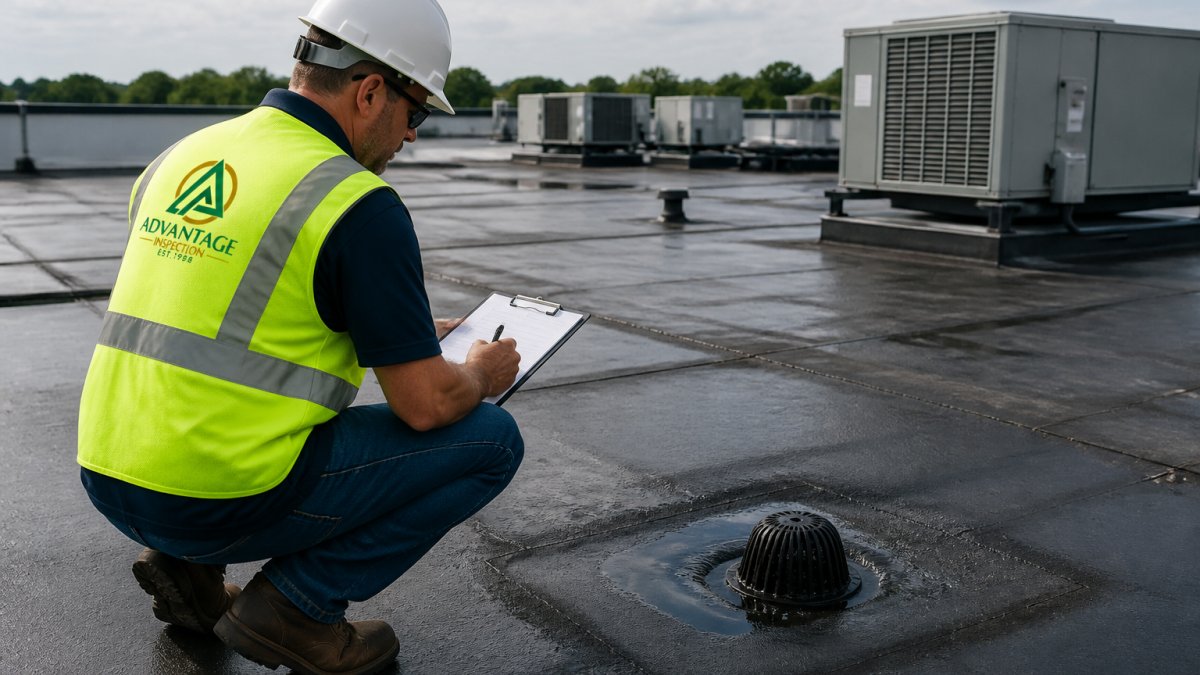
Persistent moisture or structural stress on these elevated surfaces often necessitates a professional commercial roof inspection to ensure the long-term integrity of the building envelope.
Structural Components, Building Envelope, and Roofing
The structural review covers the building slab, visible framing, columns, and load-bearing walls. Inspectors check for cracks, settlement, and signs of movement. The building envelope review looks at walls, sealant integrity, windows, and exterior doors.
Roofing gets close attention on any commercial property. Inspectors examine the roof membrane, flashing, and drainage, looking on low-slope roofs for ponding water, blisters, and open seams.
Electrical, HVAC, Plumbing, and Life-Safety Systems
The electrical review covers the service entrance, distribution panels, wiring methods, and grounding. Inspectors note capacity limits and obvious hazards, but they do not perform load calculations.
HVAC equipment and ventilation get checked for age, condition, and function. Plumbing is reviewed for supply lines, drains, water heaters, and visible leaks.
For examples of what turns up in practice, see common issues found in commercial building inspections.
Who Can Perform Inspections: NC Inspector Certification and Qualifications
Commercial inspector qualifications in North Carolina are not licensed the way residential home inspectors are, so buyers need to verify credentials directly.
The Home Inspector Licensure Board Does Not Cover Commercial Work
It does not license inspectors who examine commercial buildings, and a home inspector license is not evidence of commercial competence.
Commercial inspection is a separate field. There is no single statewide occupational license for private commercial building inspection, so the credential on a business card may come from a private trade association rather than a state agency.
What Certification Actually Means in Practice
Because the state does not issue a commercial inspector license, most practitioners build credentials through recognized commercial inspection training and certification programs, which typically require coursework, a proctored exam, supervised inspections, and ongoing continuing education.
A certification is a screening tool, not a guarantee. Two inspectors can hold the same certificate and deliver very different reports. Ask what the certification required, how long the inspector has held it, and whether it covers the property type you are buying.
What Private Inspectors Cannot Do
A private commercial inspector examines physical condition and reports findings. A private inspector cannot:
- Issue a certificate of occupancy
- Certify compliance with the North Carolina Building Code
- Approve construction or sign off on permitted work
Those functions belong to the local code enforcement official, typically a building inspector employed by a city or county, who enforces the North Carolina Building Code during permitting and construction. Confusing a private condition report with a code compliance sign-off is the most common and most expensive mistake buyers make.
How to Verify a Commercial Inspector’s Credentials
Before you sign an engagement letter, verify the following:
- Certification and training. Ask which commercial inspection certification the inspector holds, who issued it, and what the requirements were. Request the certificate number if one exists.
- Insurance. Confirm general liability and professional liability (errors and omissions) coverage, and ask for a certificate of insurance naming you or your entity as additional insured where appropriate.
- Experience with your property type. A warehouse specialist and a medical-office specialist are not interchangeable. Ask for sample reports from comparable buildings.
Ask the inspector directly: “Are you licensed by the state of North Carolina to perform this inspection?” A credible commercial inspector will explain the distinction between state licensure and private certification without hesitation. Evasiveness is a red flag.
Pending Legislation and Why It Matters
Buyers relying on a specific credential should confirm its current status before closing.
Check the UNC School of Government bill summaries for the current status of any pending commercial inspection legislation, and confirm with the North Carolina Secretary of State or the relevant licensing board whether a credential you are relying on is state-recognized or privately issued.
The Practical Takeaway
Treat certification as one input among several. The strongest signal of inspector quality is a track record of detailed, well-organized reports on buildings like yours, backed by insurance and references you have actually checked. For a fuller discussion of what the report should contain, see our breakdown of what a commercial building inspection includes.
Statewide Rules vs. Local Jurisdiction Requirements
North Carolina’s commercial building rules operate on two layers, and understanding which layer governs which question is the difference between a smooth closing and a delayed one. The state sets the technical code; local jurisdictions run the administrative process that applies it.
The Statewide Layer: One Code, Statewide Application
Technical building code requirements are generally applied at the state level, with local jurisdictions enforcing them during permitting and construction. Because the code is adopted at the state level, technical requirements for a given building type are largely consistent statewide.
What the state code does not do is tell you how a particular city or county will process a permit, schedule an inspection, or issue a certificate of occupancy. Those are local functions.
The Local Layer: Permitting, Inspections, and Certificates of Occupancy
Local code enforcement officials enforce the state code during permitting and construction. The local jurisdiction typically controls:
- Permit intake and plan review. Which permits are required, what plans must be submitted, and how long review takes.
- Inspection stages. The sequence and timing of foundation, framing, rough-in, and final inspections.
- Certificate of occupancy. The process for obtaining a CO, including any punch-list or re-inspection requirements.
How to Determine Which Rules Apply to a Specific Property
Before closing, work through these steps:
- Identify the governing jurisdiction. Confirm whether the property sits inside a city limits, in an unincorporated area served by the county, or in an area with a joint or regional inspection department. The permitting authority follows municipal boundaries, not ZIP codes.
- Pull the permit history. Ask the seller or the local permitting office for the permit history on the building. Unpermitted work is one of the most common due-diligence findings and can trigger retroactive permitting requirements.
- Confirm the certificate of occupancy status. Verify that the current use matches the CO on file. A change of use, for example, converting retail space to a restaurant, typically triggers a new permitting and inspection process.
- Contact the local fire marshal. Confirm life-safety system status, including sprinkler and alarm records, and ask whether any local amendments apply to the occupancy.
- Ask about local amendments and overlays. Some jurisdictions adopt local amendments or historic-district overlays that add requirements beyond the state code.
Do not assume that a building’s existing certificate of occupancy covers your intended use. A CO is issued for a specific occupancy classification, and changing use can require new permits, new inspections, and a new CO, a process that can take weeks or longer and should be built into your due diligence timeline.
What Varies and What Does Not
| Item | Set by state | Set by local jurisdiction |
|---|---|---|
| Technical building code requirements | Yes | No (local amendments may add) |
| Permit forms and intake process | No | Yes |
| Inspection sequencing and scheduling | No | Yes |
| Certificate of occupancy issuance | No | Yes |
| Fire marshal life-safety review | Partially | Yes |
| Permit and re-inspection fees | No | Yes |
Why This Matters for a Private Inspection
A private commercial inspection is not a code compliance review, but the inspector’s familiarity with the state code and local procedures directly affects report quality. That local knowledge is one reason to confirm coverage in your area before engaging an inspector, review the areas we serve if you need to confirm.
For the inspection itself, treat the local jurisdiction as a separate due-diligence workstream running in parallel with the physical inspection. The physical report tells you what condition the building is in; the local jurisdiction tells you what you will need to do to use it the way you intend.
Commercial Property Inspection Cost: What Drives the Price
Commercial property inspection cost depends on several factors, not a flat rate. Pricing reflects the time and expertise a given building demands.
The main drivers:
- Square footage. Larger buildings take longer to inspect.
- Property type. Warehouses, restaurants, and medical offices each carry different system complexity.
- Building age and condition. Older buildings with deferred maintenance take more time to document.
Pricing depends on the building and scope. For a quote on your property, contact our team directly.
Commercial Property Inspection Duration: How Long It Takes
Commercial property inspection duration runs longer than a residential inspection.
Timeline also depends on report turnaround. Ask upfront when the written report will be delivered, since your due diligence period depends on it.
Commercial Property Due Diligence Checklist for Buyers
A commercial property due diligence checklist keeps your review organized before closing. Use this as a starting framework:
- Confirm the inspection scope in writing
- Verify inspector credentials and insurance
- Obtain and review the condition report
Build in time for re-inspection if deficiencies need follow-up. A re-inspection fee may apply, so budget for it.
Schedule Your Commercial Building Inspection
The gap between a good commercial deal and a bad one often comes down to what the inspection found before closing. Requirements vary, jurisdictions differ, and the report is only as good as the inspector behind it.
Advantage NC has completed over 500,000 inspections since 1988, backed by a verified 4.9-star rating from more than 1,900 reviews.
Get started with Advantage NC and schedule your commercial building inspection with confidence.
Frequently Asked Questions
Are commercial property inspections required before closing in North Carolina?
North Carolina does not mandate a commercial property inspection before closing, but most lenders and buyers treat it as a standard part of due diligence. A private commercial inspection is separate from the code-enforcement inspections tied to permitted construction. Skipping it means you accept the building’s condition without direct observation of the roof, electrical distribution, HVAC equipment, or structural components. Confirm deadlines in your purchase contract and schedule the inspection early enough to allow re-inspection if deficiencies turn up.
What does a commercial building inspection checklist typically include?
A commercial building inspection checklist usually covers structural components and the building envelope, roof membrane and drainage on low-slope roofs, flashing and sealant integrity, electrical distribution, HVAC equipment and ventilation, plumbing systems, and life-safety systems. Inspectors also note accessible ceilings, walls, floors, stairs, railings, restrooms, utility spaces, loading areas, and signs of water intrusion or ponding water. Because the scope is direct observation rather than destructive testing, the checklist documents visible conditions and recommends follow-up by licensed trade specialists where needed.
How much does a commercial property inspection cost?
Commercial property inspection cost depends on building size, property type, number of systems, and travel, so quotes vary widely and pricing should come directly from the inspection provider. Larger buildings, multi-tenant properties, and specialized assessments such as environmental testing add to the total. Ask what the quote includes: report format, re-inspection fees, and whether ancillary services are bundled or billed separately. Getting a written scope alongside the price helps you compare proposals on equal terms.
How long does a commercial property inspection take?
Commercial property inspection duration depends on square footage, building complexity, and how many systems need review. A small retail or office building may take a few hours, while a multi-story or multi-tenant property can take a full day or more. Build extra time into your due diligence period for re-inspection if the report identifies deficiencies that need a second look before closing.


Recent Comments