

Last Updated: October 26, 2026
Quick Summary
Mold testing matters for buyers because it confirms hidden growth, resolves disputes, and documents conditions for negotiation before closing. Test when you need to verify concealed moisture problems, and skip it when visible mold and an obvious moisture source already tell you what to fix.
- A home’s resale value can drop 20% to 37% because of mold issues.
- A visual mold inspection typically costs roughly $200 to $600 for a standard single-family home.
- Air sampling runs roughly $50 to $150 per sample, plus lab analysis.
- The EPA says sampling is generally unnecessary when visible mold growth is present.
- Half of interested buyers reportedly walk away from a home after learning it had mold.
Table of Contents
- Why Mold Testing Deserves a Place in Your Due Diligence
- Mold Inspection Before Buying a House: What It Actually Covers
- Mold Inspection vs. Mold Testing: Knowing Which One You Need
- What to Do if Mold Is Found During a Home Inspection
- Mold Testing Cost and Who Usually Pays
- How Mold Affects Property Value, Health, and Negotiations
- When Testing May Not Be Necessary, and Where It Falls Short
- Book Your Pre-Purchase Mold Assessment with Advantage NC
- Frequently Asked Questions
Why Mold Testing Deserves a Place in Your Due Diligence
A home’s resale value can drop 20% to 37% because of mold issues, according to RubyHome’s mold statistics.
Here is the part most guides get wrong. Mold testing is not a pass-or-fail exam. For the full picture, see our home-buying due diligence checklist.
Below, we break down the seven reasons mold deserves a real place in your due diligence, plus when testing is genuinely unnecessary.
Mold Inspection Before Buying a House: What It Actually Covers
A mold inspection before buying a house is a visual and technical assessment of moisture conditions, not a guarantee that every spore is mapped. The inspector looks for water intrusion, musty odor, discoloration, and conditions that feed growth.
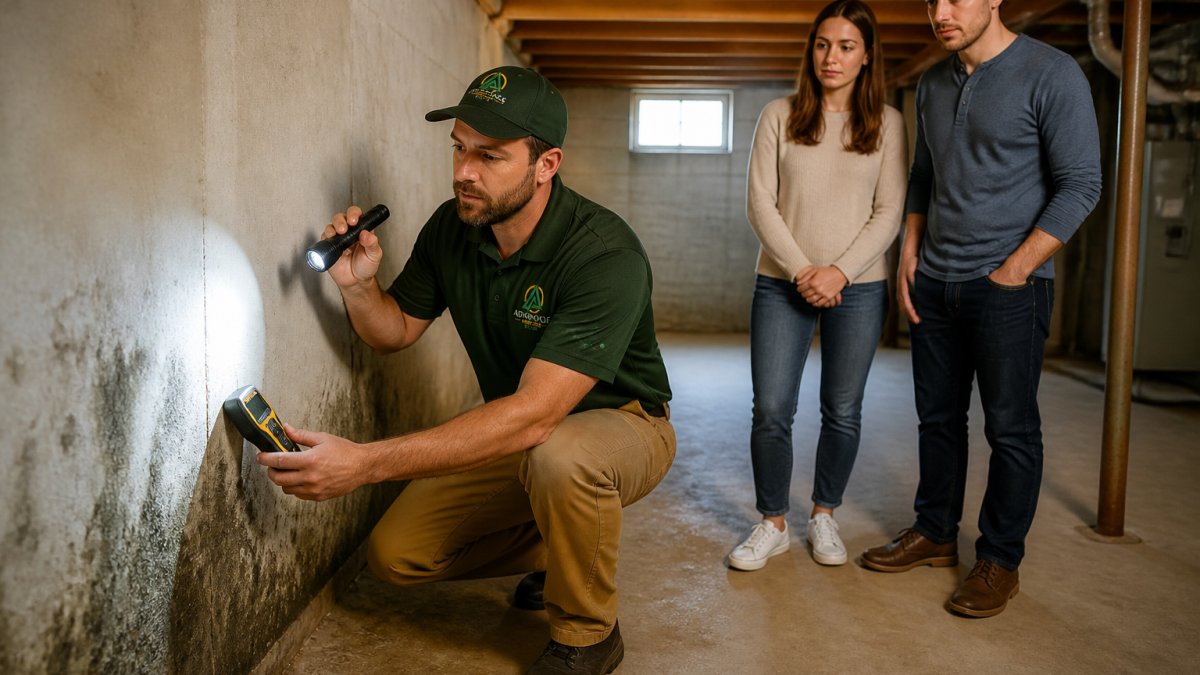
Identifying these hidden colonies early allows you to better understand the scope of the mold remediation process and the necessary steps to restore a healthy living environment.
What a standard assessment typically includes:
- A walkthrough of the attic, basement, crawlspace, and finished spaces
- Moisture readings at suspect walls and floors
- Checks around the HVAC system, supply vents, and condensate lines
- Review of the water history and any prior repairs
Hidden Mold and Moisture Problems a Visual Walkthrough Can Miss
The nastiest problems hide where a flashlight barely reaches. Moisture intrusion behind drywall, under flooring, or inside an HVAC plenum can grow mold for months without a visible stain. A musty odor with no visible mold is a classic warning sign. If you notice damp smells or unexplained moisture, our guide to moisture issues and their solutions walks through the signs and fixes.
Signs That May Warrant Further Investigation
Some red flags justify a closer look, and possibly air sampling or surface sampling. Watch for:
- Visible mold or mildew on walls, ceilings, or window frames
- A persistent musty odor in specific rooms
- Water stains, bubbling paint, or warped trim
- Past water leaks, flooding, or a repaired water heater
Our inspectors also watch for the common mold indicators that show up during a standard walkthrough.
Mold Inspection vs. Mold Testing: Knowing Which One You Need
Mold inspection and mold testing answer different questions. An inspection finds the conditions that cause mold. The EPA’s guidance on mold testing is blunt: sampling is unnecessary in most cases when visible mold growth is present.
| Factor | Mold Inspection | Mold Testing |
|---|---|---|
| What it finds | Moisture sources and visible growth | Spore types and counts |
| Method | Visual and moisture readings | Air or surface sampling |
| Best for | Most buyers, most situations | Confirming hidden or disputed growth |
| Turnaround | Same day report | Lab analysis adds days |
If you are unsure which fits your situation, this guide on when buyers should order mold testing lays out the common reasons to recommend it.
What to Do if Mold Is Found During a Home Inspection
Finding mold is not a reason to walk away. It is a reason to get specific. First, identify the moisture source. Mold without a water problem returns.
A practical sequence:
- Ask the inspector to document the extent and any moisture readings
- Request a qualified mold remediation estimate from a licensed contractor
- Get a follow-up inspection after remediation to confirm the fix
- Use remediation documentation in your real estate negotiation
- Keep a buyer contingency in place until you have answers
Watch out: cleaning visible mold without fixing the moisture source almost always leads to a repeat problem, and you will pay twice.
Mold Testing Cost and Who Usually Pays
Mold testing cost is not a single line item. Buyers who understand the components negotiate better and avoid surprise invoices. Pricing varies by property size and scope.
Typical cost components (national ranges, USD):
- Visual mold inspection / moisture assessment: roughly $200 to $600 for a standard single-family home. This includes a walkthrough, moisture meter readings, and a written report with photos.
- Air sampling: roughly $50 to $150 per sample, plus lab analysis. Most assessments use two to four samples (indoor living area, a suspect room, and an outdoor control).
- Surface or bulk sampling: roughly $40 to $100 per sample, often used to confirm visible growth or a stained material.
- Laboratory analysis: usually bundled into the per-sample fee, but ask whether the lab is accredited (for example, by the American Industrial Hygiene Association’s EMLAP program) and whether the report includes spore counts by genus.
Any quote given without a walkthrough is a guess, insist on a written scope that lists sample count and locations.
Who pays:
- Buyer: In most transactions, the buyer pays when testing is ordered during the inspection contingency period. It is treated like any other due-diligence cost.
- Seller: A seller may cover testing or remediation when a disclosure issue surfaces, when a prior repair is disputed, or as a negotiation concession. Get any seller-paid assessment in writing, including who selects the provider.
- Split: In competitive markets, buyers sometimes ask for a credit at closing rather than a pre-closing repair. A credit shifts the work and risk to you after closing, price it accordingly.
Ask for an itemized quote: inspection fee, number of samples, lab fee per sample, and report turnaround. A provider who will not itemize is a provider who will surprise you.
Questions that change the price:
- How many samples, and where exactly?
- Is the lab accredited, and does the report include outdoor control samples?
- Is the assessment independent of any remediation company?
- What is the turnaround time, and does it fit your contingency deadline?
How Mold Affects Property Value, Health, and Negotiations
Half of interested buyers reportedly walk away from a home after learning it had mold, per RubyHome’s 2026 statistics. That is the marketability risk sellers fear and buyers can use. On the health side, the CDC/NIOSH guidance on mold notes there are no health-based standards for mold in indoor air, which is exactly why documentation matters more than scare tactics.
Mold affects three things at once:
- Property value: visible or disclosed mold weakens your negotiating position
- Health concerns: sensitive occupants may react to indoor air quality issues
- Marketability: future buyers will ask the same questions you are asking now
When Testing May Not Be Necessary, and Where It Falls Short
Testing is a tool, not a verdict. Knowing when to skip it, and what a result can and cannot prove, protects you from both unnecessary spending and false reassurance.
When testing may not be necessary:
- Visible mold is already confirmed. The EPA’s guidance is direct: sampling is generally unnecessary when visible mold growth is present. Spend the money on source repair and remediation instead.
- The moisture source is obvious and being repaired. If a supply line leaked and the cabinet is being replaced, sampling adds little.
- You need a fast decision and visual evidence is enough. A documented moisture reading and photo can support a negotiation without lab turnaround.
- The home is new construction with no water history and no odor. A standard home inspection with moisture checks is usually sufficient.
Where testing falls short, and why a negative result is not a clean bill of health:
- A sample is a snapshot. Air sampling captures spores in the air at that moment, in that room. Mold counts vary with weather, HVAC operation, occupancy, and recent cleaning. A low count on a dry day does not rule out growth behind drywall.
- Results depend on sampling conditions. Windows open, fans running, or a recently vacuumed room can dilute or redistribute spores. Ask whether the inspector followed a consistent protocol (closed-house conditions, calibrated pumps, outdoor control sample).
- There are no federal health-based standards for mold in indoor air. The CDC and NIOSH note this explicitly. Labs compare indoor samples to outdoor controls and to each other, not to a legal limit. Interpretation is contextual.
- A negative result does not rule out hidden moisture. Mold needs water, not spores in the air. If moisture readings are elevated, the moisture problem exists regardless of what the air sample says.
- Surface sampling can miss the source. A swab of visible growth confirms what is on the surface, not where the water is coming from.
Do not treat a clean air sample as permission to skip moisture investigation. A dry-looking sample and a wet crawlspace can coexist. The moisture reading is often the more actionable finding.
How to read results in context:
- Compare indoor samples to the outdoor control. Elevated indoor counts of genera like Aspergillus/Penicillium or Stachybotrys relative to outdoors warrant follow-up.
- Pair lab results with moisture readings and a visual report. A result without moisture context is incomplete.
- If results arrive near closing, do not let a deadline force a decision. Ask for an extension of the inspection contingency in writing, or negotiate a credit that reflects the uncertainty.
The buyer’s decision rule: test when you need to confirm hidden growth, resolve a dispute, or document conditions for negotiation.
Book Your Pre-Purchase Mold Assessment with Advantage NC
The real challenge is not finding mold. It is knowing whether the moisture behind it will cost you thousands after closing. Advantage NC has completed over 500,000 inspections and carries a verified 4.9-star rating from more than 1,900 reviews. We also offer mold testing and indoor air quality services alongside home inspection, radon gas testing, and sewer scope inspection.
Get started with Advantage NC and enter your transaction with clear answers instead of guesses.
Frequently Asked Questions
Is mold testing necessary when buying a house?
Not always. The EPA says sampling is unnecessary in most cases when visible mold growth is present, because the mold is already confirmed and the fix is moisture control. Testing earns its place when you suspect hidden mold: a musty odor with no visible growth, past water damage, or a finished basement with no water history. In those cases, air or surface sampling with laboratory analysis gives you documentation you can use in negotiations. A qualified inspector can tell you whether testing adds information or just adds cost.
What can mold testing tell a homebuyer that a visual inspection cannot?
A visual inspection finds what is reachable and visible. Mold testing adds laboratory analysis of air or surface samples, which can show whether spores are elevated indoors and whether growth exists behind walls, under flooring, or inside HVAC systems. It also produces a written record you can attach to a repair request. What it cannot do is set a health threshold: the CDC/NIOSH notes there are no health-based standards for mold in indoor air, so results are interpreted alongside moisture findings, not as a pass or fail grade.
How much does mold testing cost, and who pays for it?
Pricing depends on the scope: how many samples are taken, whether air or surface sampling is used, and how large the property is. Advantage NC does not publish flat rates because every assessment differs, so ask for a quote based on the specific home. In most transactions the buyer orders and pays for testing as part of due diligence. If findings are significant, buyers sometimes negotiate a credit or remediation by a licensed contractor, but that depends on your contingency terms and the seller’s willingness.
Can I skip the inspection contingency if my realtor says it weakens my offer?
Waiving the inspection contingency removes your main route to renegotiate or walk away if mold, moisture intrusion, or water damage turns up. In a competitive market that trade-off is real, but so is the risk: resale value can drop 20% to 37% because of mold issues, and roughly half of interested buyers reportedly walk away from a home that had mold. A pre-offer walkthrough or a shortened contingency window can strengthen an offer without giving up all protection. Talk through the specific terms before you sign.


Recent Comments